Here is your horror movie watch list, curated by me, a woman who's seen a lot of movies, podcasts about them weekly, has written and spoken about horror, and is not taken seriously.
Isolation
It's out there, patient and invisible. We shut ourselves up inside our homes, but we can't escape its presence. It lingers in the gutters, between the panels of our secure moments, waiting for us to touch our face.
Solo
All new camp counselors must go on a two-day solo trip on a nearby island. Which is said to be haunted. No big deal, right? Wrong! Gillian is not alone on the island, and her benign solo adventure turns into a true survival test.
The Interior
The woods are creepy at night. What's making all those noises out there, in the dark? Is it just animals? Or is it your own imagination, your crumbling sanity made manifest?
Uncertainty
Daily we ride a roller coaster of emotion. We're hopeful, then fearful, then panicked, then hungry. We're bombarded with conflicting messages and predictions, politically-motivated op-eds, and TikTok videos. Who are we to believe about what's really going on? How long will this "new normal" last? When will our Amazon package arrive? None can say.
Containment
Imagine waking up to find yourself trapped in your apartment. Imagine not being able to text or google, and the only contact from the outside is a message to remain calm. Now imagine that you've banded together with your neighbours and together you try to figure out what's going on but the conversation just goes in circles because no one has any new information and the doctor you've kidnapped is unforthcoming. Finally imagine that you're determined to survive this thing, whatever it is.
The Lapage's Demon
Is it possible to predict every outcome of every scenario imaginable given a certain set of circumstances? Truly death is the only constant, inevitable. It's just a matter of when.
In the Mouth of Madness
Horror novelist Sutter Cane has disappeared, but his work endures. In more ways than one. When his investigation leads him to the should-be-fictional town of Hobb's End, insurance investigator John Trent finds more questions than answers. Primary among them being, what the hell is going on in this movie? Is he going crazy? Is he a character in a book? Let me know if you figure it out.
Time Marches Ever Onward but has Lost All Meaning and We are Adrift in a Sea of Tuesdays
You've been wearing the same comfy outfit for days. Nothing changes inside or out. Sometimes the sun shines, sometimes it rains. The monotony of work-a-day life has been replaced with the monotony of work-from-home life, now punctuated by video conferences instead of coffee breaks. At least you don't have to put on pants.
Happy Death Day
Happy birthday dear friend! Better enjoy it while it lasts because it will be your last, which you will relive again and again and again and again and again and again and again and again until you figure out who killed you.
Triangle
A day cruise turns deadly when Jess and her friends are stalked by a figure with an axe. Worse yet, they seem to stuck in a loop in which they die over and over and you get the point. Only you don't get the point, not really, because this movie is a total mind-fuck.
Existential Dread
All of it, the physical distancing and social isolation, the uncertainty, the perpetual motion of the eternal return have at last instilled within us our sense of place in this world. And that place is neither safe nor secure. Our insignificance is overwhelming; we don't matter. We are matter, and nothing more.
The Void
A mad doctor opens a portal to a dark dimension but not before the irresistible influence of The Void is felt by those trapped inside his hospital.
The Prince of Darkness
A priest asks a scientist for help studying a religious artifact, but neither one is prepared to fully understand what's really going in with that thing in the basement. A fun surprise awaits fans of DJ Shadow.
Body Parts
What is the true nature of being? Are we, each of us, a singular and unique whole, or are we a sum of parts, each one imbued with its own vital essence? Where does the soul live and, more importantly, where does it go after we've shed this mortal coil? Also, is it possible to transplant a head?

Friday, 10 April 2020

Saturday, 28 July 2018
Nail Gun Massacre
Nail Gun Massacre is a weird movie. Also, a bad movie. A weirdly bad movie. It's your typical rape-revenge fare, but with a slight twist. A twist that could have worked, but doesn't.
Here's the killer all dressed up:


It's pretty clear that's a woman under the camo. And she's none too tall.
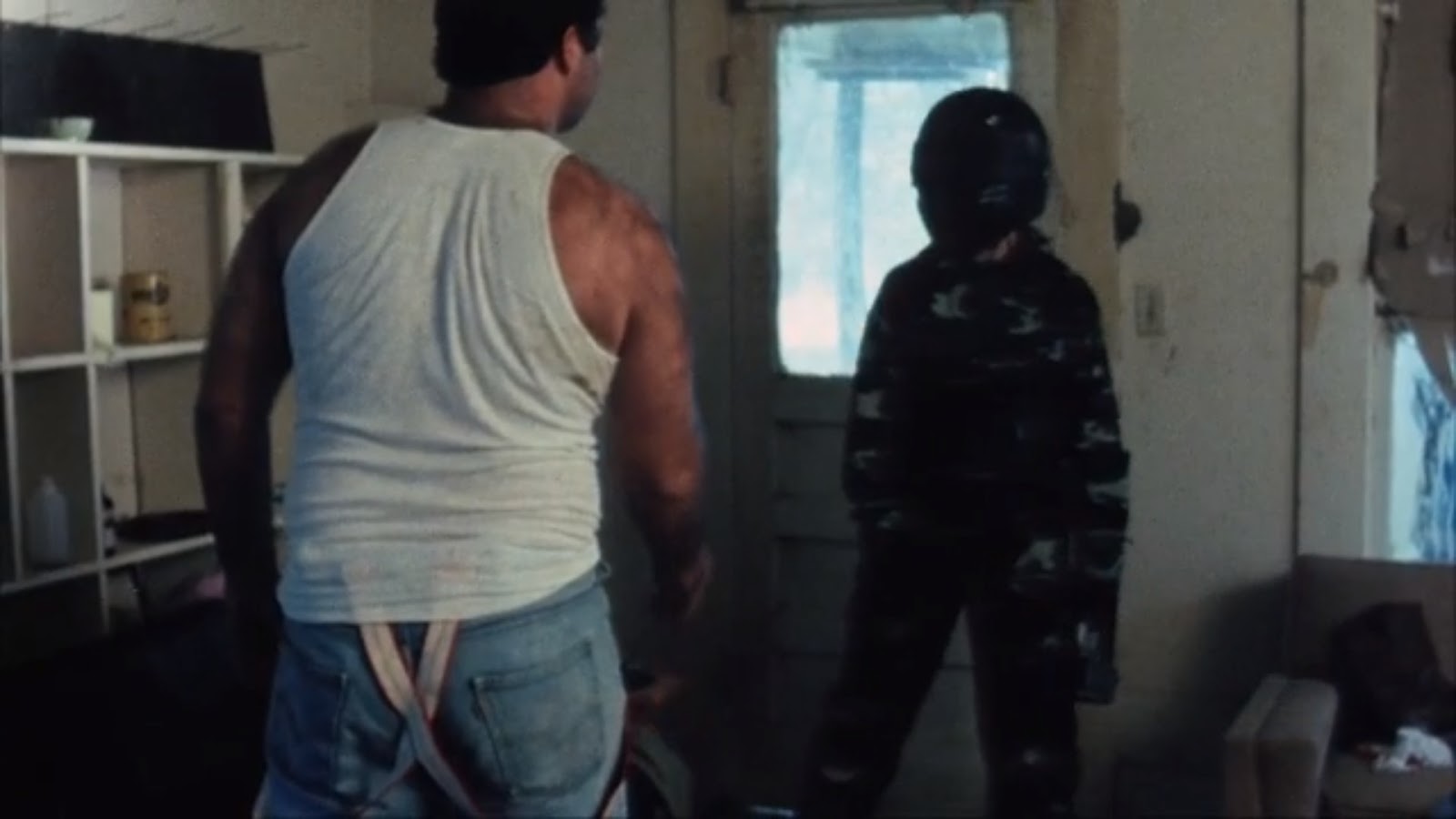
Here's the killer, unmasked:

And here he is standing next to his sister, the woman who should be the killer:

There is simply no way Bubba could be the camouflaged nail gun killer. I get what the film was going for, I really do, but it doesn't come by its twist honestly. And for that reason the movie, on the whole, fails to make the grade.
And then there's the last shot:

This puzzling image is accompanied by a musical sting, an ominous tone meant to suggest the killings aren't over. The man on the left is the handsomest doctor is all of Christendom. He's been working with the Sheriff to figure out who's killing the town's carpenters. Dr. Sexy refuses to believe the sister is the killer. He's right, of course. But what to make of the two of them walking hand-in-hand into the sunset? Are they an item? Will he avenge her now that her brother's dead and can no longer carry her burden? Or will she take her own revenge on whoever's left?
That's a valid question, because the killer nail guns everyone he comes across. Not just the men who raped his sister, but anyone in his eye line:

Girls.

Couples.

And a hitchhiker just looking for a ride.

I don't know who this dead woman is, and neither does the movie.
There are many ways to (try to) explain why Nail Gun Massacre is such a mess, and each one is just as believable/unbelievable as the next. Suffice to say, and at the risk of repeating myself, this movie is bad in a bad way.
Here's the killer all dressed up:
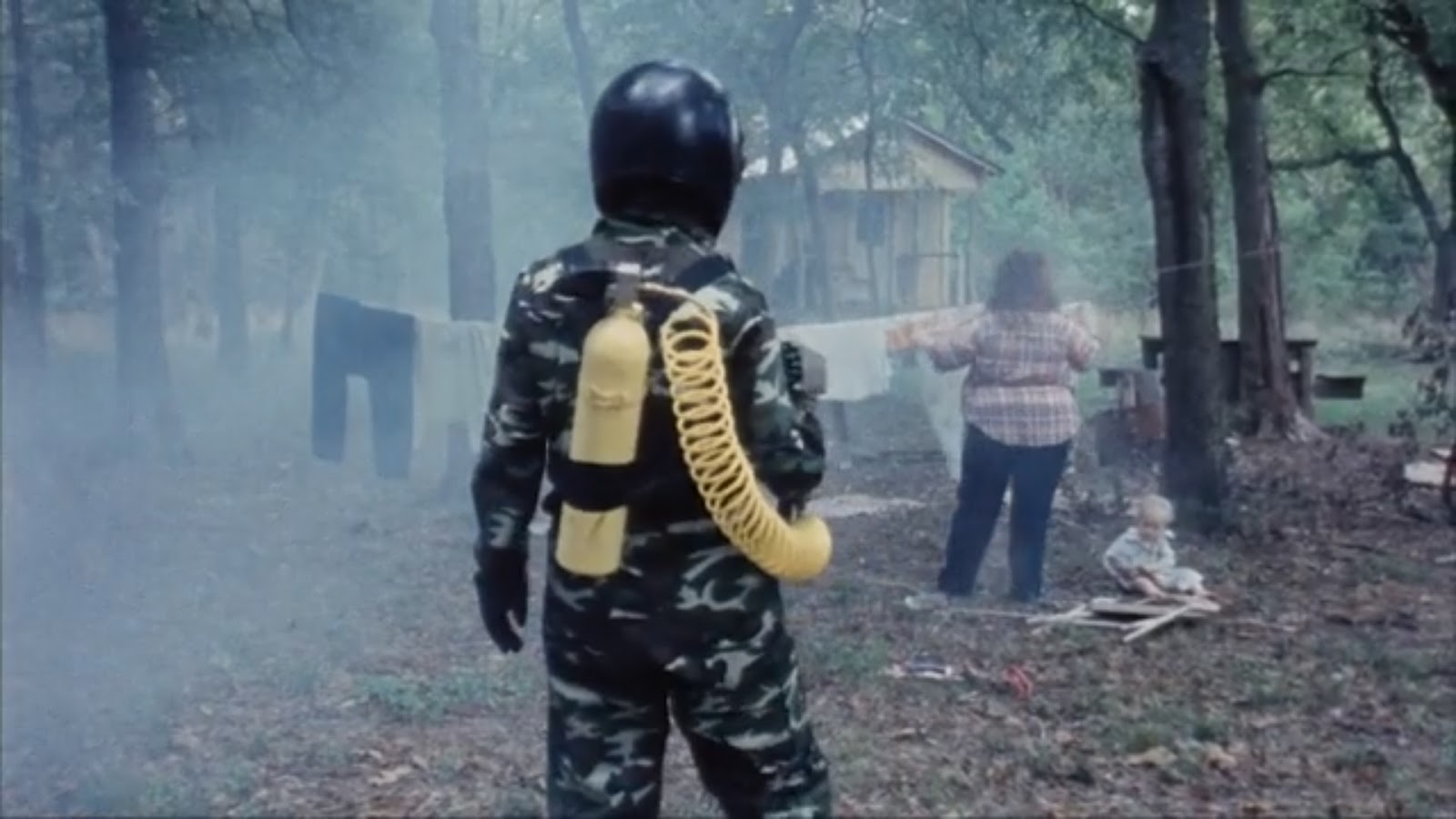
It's pretty clear that's a woman under the camo. And she's none too tall.
Here's the killer, unmasked:

And here he is standing next to his sister, the woman who should be the killer:
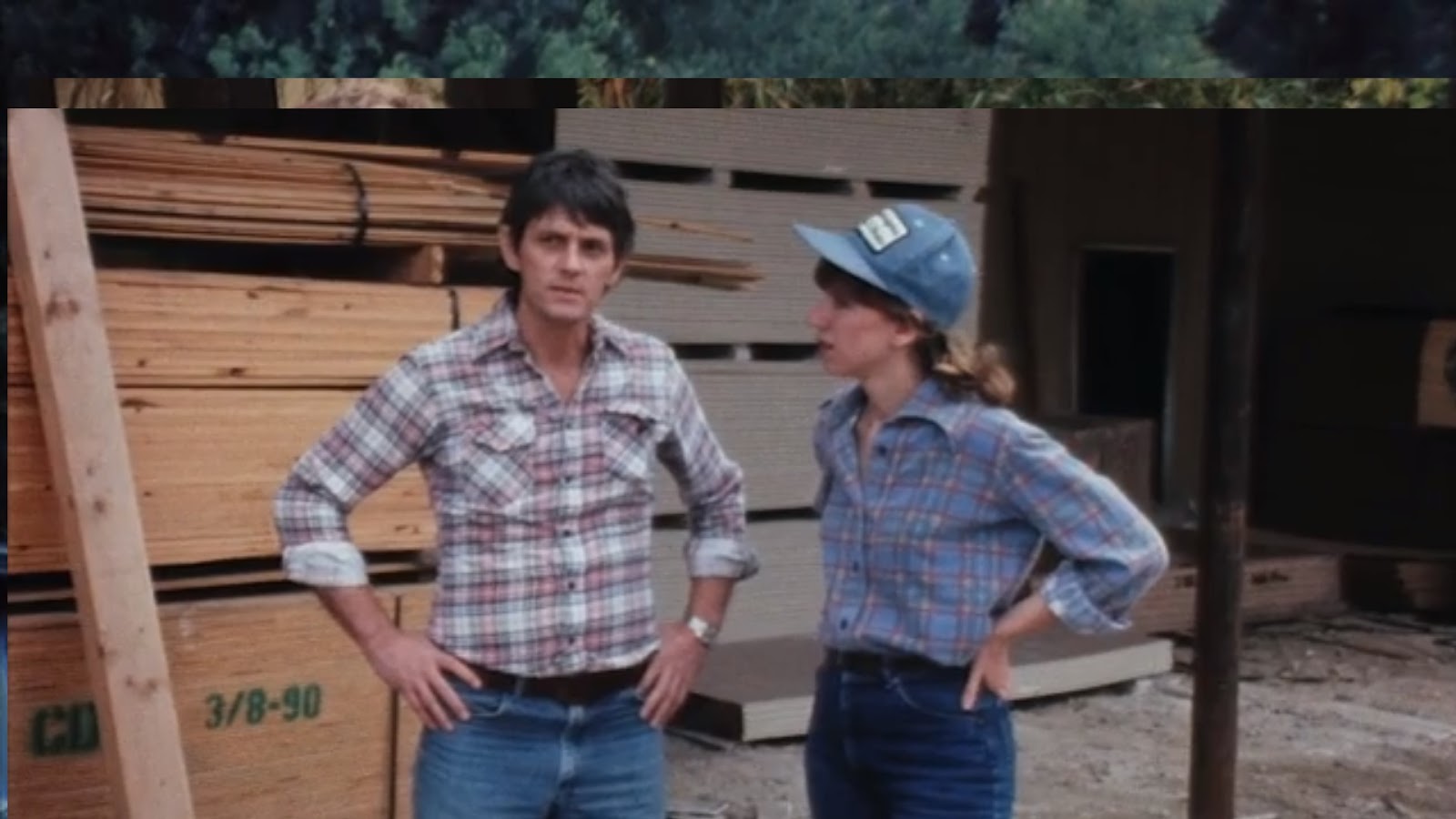
There is simply no way Bubba could be the camouflaged nail gun killer. I get what the film was going for, I really do, but it doesn't come by its twist honestly. And for that reason the movie, on the whole, fails to make the grade.
And then there's the last shot:

This puzzling image is accompanied by a musical sting, an ominous tone meant to suggest the killings aren't over. The man on the left is the handsomest doctor is all of Christendom. He's been working with the Sheriff to figure out who's killing the town's carpenters. Dr. Sexy refuses to believe the sister is the killer. He's right, of course. But what to make of the two of them walking hand-in-hand into the sunset? Are they an item? Will he avenge her now that her brother's dead and can no longer carry her burden? Or will she take her own revenge on whoever's left?
That's a valid question, because the killer nail guns everyone he comes across. Not just the men who raped his sister, but anyone in his eye line:

Girls.

Couples.

And a hitchhiker just looking for a ride.

I don't know who this dead woman is, and neither does the movie.
There are many ways to (try to) explain why Nail Gun Massacre is such a mess, and each one is just as believable/unbelievable as the next. Suffice to say, and at the risk of repeating myself, this movie is bad in a bad way.
Tuesday, 29 May 2018
Solo: A Star Wars Story

I am the worst kind of Star Wars nerd. I LOVE the original trilogy, and read a ton of EU in my teen years. I've since forgotten most of what I knew (which was a lot), but I still cling to the good ole days, before the OT was re-released with that celebratory scene on Coruscant that MADE NO SCENE. SERIOUSLY, IT TAKES TIME FOR NEWS TO TRAVEL TO THE CENTRE OF THE GALAXY WHERE THE EMPIRE IS STILL VERY MUCH IN CHARGE.
Hearing the expanded universe was deleted upon the release of The Force Awakens was tough. But I got over it (read: myself) and enjoyed the film for the fun adventure it was. Rogue One was pretty good minus the incomprehensible decision to cut away from the super star destroyer crashing into the shield generator, and the equally stupid idea to name a planet Jedha. And with the exception of one wholly unnecessary space Monaco sequence, The Last Jedi was a great ride.
All this is to say, I got on board with the new crop of Star Wars movies, which was no mean feat given the giant kick in the nuts that was the prequels. But then along came Solo: A Star Wars Story and all its bad press and even worse trailers. (Also, I might add the marketing: Memorial Day is meaningless to people outside the United States, so plastering that all over the initial advertisements kind of alienates non-US audiences.) I was not looking forward to this movie. Seeing it was a chore, and I paid the least amount of money I could--five whole dollars.
Did I get my money's worth? I guess so. Solo is really just a big heist movie, and probably owes more to Firefly than any part of the Star Wars EU, old or new. That having been said, it does include more nods to the OT than any other Star Wars film to date, but it'll still take me a while to accept the new version of how Han and Chewie met. Also there's not a wipe to be seen.

More bad news: poster plagiarism?
I didn't walk out of the theatre hating Solo, and as I stood on the subway platform, waiting for the northbound train, I thought I'd probably like the movie even more once I'm further separated from it in time. It's now been about two hours since I the credits ended, and while I'm still not prepared to say I liked the movie, I'll admit that it's not nearly as bad as I imagined.
Still, there are some nits that I can't help but pick. Like how Enfys Nest's theme sounds a lot like the choral pieces from the 1995 Ghost in the Shell soundtrack. And when Enfys takes off her helmet and we see her for the first time, it's shot and scored as a big moment except that we have no idea who she is. What'st the point of building up this reveal for a character we don't know? Finally, with respect to Enfys, there's a missed opportunity when she's talking about what the coaxium represents; not once does she say the word hope. I could go on about how Alden Ehrenreich seems like he's channeling Chris Pine's Kirk, or about Qi'ra's grossly underwritten backstory, but I'll save it for another rant (be sure to check out TheAvod episode 437!).
Solo doesn't do anything to enrich the story which unfolds in the other Star Wars movies. It's a stand-alone, a one-off that ends with a tie-in to A New Hope and...The Phantom Menace?!? On the one hand, I'm glad the film is a self-contained adventure, but on the other hand, it doesn't feel like a Star Wars movie. Yeah, there's an Empire and whatnot, but the story being told could be about any rag-tag band of thieves stealing anything in any universe (see Firefly comment above).
The ultimate test of whether this film passes muster is if I'll see it again. And the answer is probably. On Netflix. Which is more than I can say for Rogue One or The Last Jedi, two films I liked better but have yet to watch a second time. Make of that what you will.
Tuesday, 28 November 2017
Darken

Darken provides. More to the point, Mother Darken provides me with Canadian scifi. If you're not overly familiar with Canadian scifi, it has a certain look and feel. There's something distinctly...Canadian about it. A kind of mild claustrophobic atmosphere.
Anyway, Darken is a new film from Audrey Cummings, and very different from her previous outing, Berkshire County. Eve, a nurse who's struggling with having lost a patient, suddenly finds herself trapped inside Darken, a world of seemingly infinite, interconnected rooms. Presently, Darken is ruled by Clarity who is slowly consolidating her power. Claiming to act on Mother Darken's behalf, Clarity won't tolerate any talk of a world beyond Darken and is swift to persecute dissenters. Eve's presence in Darken threatens Clarity's hold over her people and, well, we can't have that.
What follows is your standard dystopian plot, with plenty of action and drama. As Eve stumbles her way through the world, she learns about its dangers and secrets. Not all is revealed to her, and that's one of the film's strengths--there's still a good amount of mystery left in the world. For instance, although we learn the fate of Mother Darken, the world's absentee creator, we don't know where she came from. And when the film ends, Eve and her friends find themselves staring down a new beginning.
Darken reminded me of The Odyssey, a TV show from the early 90s which I really liked. It, too, is about a stranger in a strange land trying to find their way home, and guess that's something we can all understand on some level--the desire for the familiar comforts of home. In Darken, each room belonged to someone, but the rooms themselves aren't inviting, making the world that much more alienating and foreign.

Weirder still, no one in Darken can remember their life before they arrived. All they know is they were lost, and Mother Darken gave them sanctuary. If this sounds vaguely like a metaphor for suicide, know that I thought the same thing. The idea is further reinforced by the fact that one of the characters did try to kill himself at some point in the past. Thankfully, the movie stops short of becoming allegorical, as the focus is--and should be--on the shifting power dynamics within Darken. Whatever this world is, it's in turmoil. And whoever these people are, they've got some hard choices ahead.
Darken was conceived by RJ Lackie, who's vision was so big that Darken has been developed in a series. Watching the film feels a bit like watching a really good pilot, only better. Sure, there's the standard introduction of characters and a brief orientation to the world of the film, but it's satisfying in a way pilots seldom are. Probably because Lackie knows where he wants his story to go, and Darken's plot is self-contained.
Darken closed out the 2017 Blood in the Snow Film Festival, and was (clearly) one of this reviewer's favourites. And that's not just because I have a soft spot for Canadian scifi. Darken is a testament to what can be accomplished with a great idea and a fairly limited budget.
Darken was preceded by the short film Banshee, another festival highlight. In it, a young girl struggles to fall asleep, haunted by bad memories of that time she got lost in the woods. Her big sister has run out of patience, and the two strike a bargain: big sis won't tell mom and dad about little sister's drawings of monsters in the woods if she promises to go to sleep. Easier said than done because lil sis is sure something followed her home.
Incredibly atmospheric, Banshee does a great job balancing kid fears and teenaged frustration with same. The hateful older sister is so thoroughly unsympathetic you wind up hoping there is a monster in the house, so she can get what's coming to her. Childhood trauma be damned!
Monday, 27 November 2017
Once Upon a Time at Christmas
Blood in the Snow Film Festival is an annual film fest held in Toronto with a mandate to support, promote, and exhibit Canadian horror, genre, and underground film.


On the first day of Christmas my true love
gave to me a movie about a killer Santa and Mrs Clause. I'm not much of a
Christmas person so I'm predisposed to enjoy a killer Xmas movie. This year
Santa delivered the Canada-UK co-produced Once
Upon a Time at Christmas.
In the days leading up to Christmas, the
quiet town of Woodridge, NY, is set upon by a maniacal Santa Clause and his crazy
wife. For twelve nights, they terrorize the town, first killing a mall Santa,
then two lovers, then three members of the Frenchen family. If the victims ring
familiar it's because the killers are taking inspiration from The Twelve Days
of Christmas, and there's joy in finding what kind of mayhem each new day will
bring.
As is the case with any proper Christmas
slasher, there's a holiday-specific motivation, but the film raises the stakes
by introducing a familial angle. It is Christmas, after all—a time for family.
And as is the case with any proper family drama, the plot includes its share of
recriminations, to the point where all Jennifer really wants for Christmas if
for her parents to get divorced. It's against this unhappy backdrop the murder
spree is set.
As Christmas approaches, the police are
ever more desperate to catch the murderous pair. An unhelpful Jaws-like mayor
does a poor job balancing public safety and economics, and the FBI's presence
benefits the killers more than the cops. “A storm's coming,” says Deputy
Fullard. He's speaking literally, but the figurative (and ultimately melodramatic)
nature of his statement isn't lost on the audience, nor on the Sheriff who
calls him out.

The movie is peppered with moments like
this and I wish there were more of them because they're genuinely funny and
they underscore the outrageous events taking place on screen. The film
struggles a bit with the more dramatic plot elements, unable to attain the
gravitas it's reaching for in some scenes, and a broader approach to the
inter-personal conflict would've played better.
The plot, on the whole, is a touch
underwritten. For a movie that's ultimately about family, it's the Sheriff and
his deputy who drive the narrative. At times the film feels like it’s more
about the police response than it is about the killing spree. Were Jen more
involved in her part of the story, the film would have a bit more balance. As
it is, Jen is easily pushed around, first by her mother who makes her get a job
at the mall and then by her friend who makes her google her parents. Jen’s
total lack of agency is further underscored when, at the end of the movie, she’s
again encouraged to do something she doesn’t want to do.
Minor plot problems aside, there’s the
issue of the film’s setting and location. Certainly, parts of Ontario can pass
for parts of New York, but that illusion is destroyed when every car on screen
has Ontario plates. Also, there’s a quick establishing shot of downtown
Woodridge that was clearly filmed in a mountain town someplace out west. Are
these mistakes enough to interrupt the willing suspension of disbelief? Maybe.
Do they ruin the movie? Of course not.
But since Once Upon a Time at Christmas is
a slasher movie, most people are watching for the killers and kills. And that’s
where the film shines. The ridiculously insane Santa and Mrs. Clause are
delightful and the bloodbath they perpetrate is inversely proportionate to
their sanity. When asked about her role as Mrs. Clause, Sayla de Goede said, “My
direction was to play her bat-shit crazy.”
She did at that.
Fake Blood
Blood in the Snow Film Festival is an annual film fest held in Toronto with a mandate to support, promote, and exhibit independent Canadian horror, genre, and underground film.

I'm here faced with a difficult task:
reviewing a movie I know is good and which everyone likes for good reason, but
one I had a hard time buying into. This is a me-problem of the first order;
there is absolutely nothing wrong with Fake
Blood. The issue is me.
Some context first. In the 1980s and early
into the 90s much ado was made about violent media. In much the same way rock
music was blamed for a perceived decline in Western civilization, horror movies
and video games have been demonized by people looking to explain why the world
is changing in ways they don't like or understand. Time and again these
theories have been proven false. Violent media does not beget more violence,
and for me, the topic has been put to bed.
And then along comes Fake Blood, part documentary, part mocumentary, which seeks to
explore the topic of movie violence in relation to violence IRL. The film
begins with real-life filmmaker Rob Grant receiving a fan video in which a guy
tours a hardware store, pointing out which tools he would use to dismember a
corpse. The video sparks a discussion between Rob and his best friend (and
leading man) Mike Kovac about the nature of movie violence and their
responsibility as filmmakers as to how that violence is depicted.
Rob and Mike decided to explore this topic
further by researching violence. What follows is a genuinely interesting and
entertaining investigation into real-world violence, and it made me recall
times in my life when I've witnessed violence of one sort or another. When Rob
gets his ass kicked by a buddy trained in martial arts, I thought about when I
trained in martial arts and got punched in the face (while wearing protection)
during sparring class. A discussion about actual fights brought back memories
of that time my friends and I witnessed a street fight outside a bar. Mostly it
was a lot of fronting, and girls yelling. Then one guy walked into a punch and
it was suddenly over. These recollections jived with what was being said on
screen. Fights in real life are short and messy. Nobody wants to see that
recreated on film—they're over too quick.

After getting his ass handed to him, Rob
and friends hit up a gun range where they shoot popular movie guns, including a
pump-action shotgun and the exalted Desert Eagle. One hilarious comparison later,
and you come away with a better understanding of just how unrealistic movie gun
play really is.
Not yet satisfied in their quest for
enlightenment, Rob and Mike make the narratively important decision to
interview John, a sort of violence consultant. John tells them harrowing tales
of murder and has some insights to offer on the topic of fake vs real violence
and their consequences. This experience takes the film in a new direction, one
which puts a great deal of strain on the filmmakers’ friendship.
And here we come to the real moral centre
of the film—the movie’s not really about violence at all but about the
obsessive pursuit of story. Rob talks himself in believing he now has a
responsibility to show the consequences of violence, to explore how it impacts
people’s lives. He goes so far down that rabbit hole that he winds up putting
himself and his friends in danger. Rob and Mike become their own subjects and the
film turns in on itself before reaching its conclusion.
Everything about Fake Blood is good, but the standout moments for me are the re-enactments
of John’s stories. These sequences are beautifully shot in dreamy slow-motion,
and I honestly can’t say if it was intentional or not to bring so much artistry
to these depictions of violence. Each sequence ends with a hard cut which most
definitely is intentional—slapping the audience back to reality.
During the Q&A, the filmmakers
explained that Rob is a sensitive guy and when he received that fan video it
sparked a crisis of conscience. He really did face an moral dilemma, and
worried about the fallout from making super gory, violent movies. Again, not
something I spend a lot of time thinking about but hearing this story did help
me get on board with Fake Blood’s
premise. It also reminded me of another Q&A I attended years ago. That film
was extremely violent and not in an artsy or stylized way. When called on, a
woman in the audience berated the filmmaker for his negative portrayal of his
country and its people, and told him he, as an artist, had a responsibility to
produce beautiful things.
“I’m a filmmaker,” he said. “My only responsibility
is to make movies.”
Saturday, 25 November 2017
Buckout Road
Blood in the Snow Film Festival is
an annual film fest held in Toronto with a mandate to support, promote, and
exhibit independent Canadian horror, genre, and underground film.
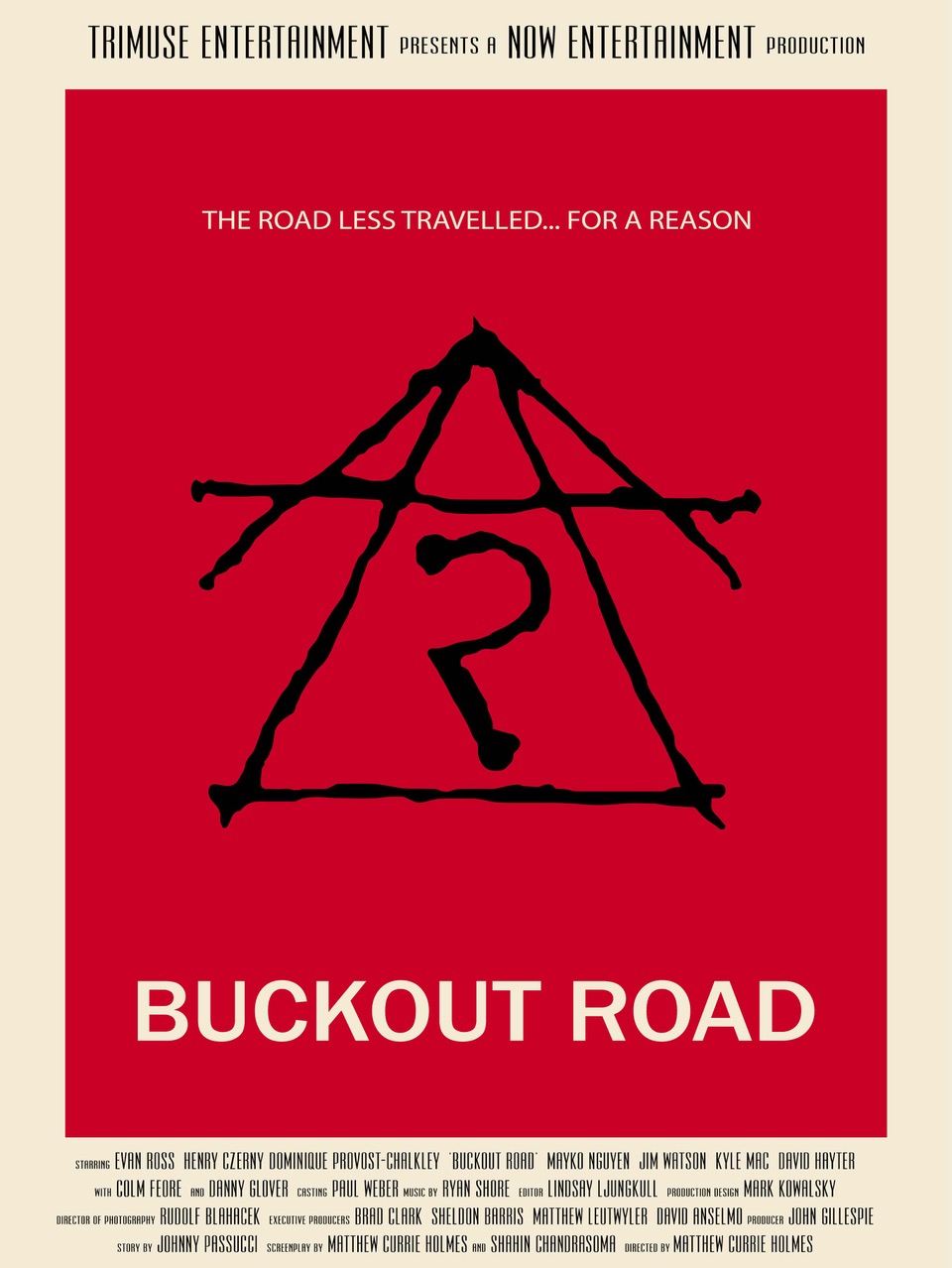
I first learned of this movie a few weeks ago, searching the Internet for upcoming horror movies to talk about on my podcast. Back then, I kinda made fun of it but my co-host was intrigued. Thing was, I'd already heard about Buckout Road--the place--but didn't know anything about the legend. And now, I guess, I do. Turns out some of the stories they tell in the film are the real urban legends associated with Buckout Road.
The film begins, as so many do, with a lecture on the movie's subject matter. In this case, a "humanities" class discusses the nature of belief systems and the need for faith. This, of course, sets the stage for a longer musing on legends and belief. Or it would if the film followed a normal trajectory. The film's final moments take viewers in a new direction. I hesitate to call it a twist (because the actual twist happens earlier in the story), really it's more of a jarring, last-minute change of course.
Shortly after Aaron returns home to his grandfather's house, he meets Cleo. Cleo, he soon learns, suffers from bad dreams and when Aarons starts having nightmares the two decide to team up. They're joined by twin bothers Erik and Derek, who've been know to sleepwalk their way to Buckout Road. As it happens, everyone's dreams relate to some aspect of the road's legend, but what do they mean?

The answer, when it comes, is a little disappointing to tell the truth. The problem lies in the fact that the film's controlling idea is completely underwritten--hence the big left turn in the plot. At the risk of ruining the movie, I'll say only this: Buckout Road isn't haunted.
For all it's faults, the movie looks good. The characters are likable, which is a plus, and, more importantly the film doesn't waste your time. How many movies have we endured in which the characters refuse to believe what they're experiencing is real, replacing forward momentum with pointless bickering? Thankfully, Buckout Road's characters are all pragmatists. Even Aaron's psychologist grandfather knows something weird is going on, and he springs into action. And Aaron's own search for answers leads him on a personal journey during which he manages to reconcile his past.
But all this good will is shot to hell when the film inexplicably abandons its ghostly premise in favour of something far more demanding in terms of the willing suspension of disbelief. When The Diabolical pulled this stunt and switched gears at the end, it was surprising, sure, but it also made sense. Buckout Road's attempt at the cinematic bait-and-switch has no satisfying pay-off.
As a final example of how the film doesn't know how to handle its subject matter, I turn to the use of legend within the story. Partway through the film, Aaron visits a church where the priest shares with him a bit of local history and then tells him a highly abridge version of the Descent of Inanna. In the movie version, the goddess Inanna is sent to hell and when she returns she's surrounded by demons so Enki, Lord of the Earth, takes her place in hell so she can be free. The priest tells Aaron the story is known in many religions, and says the Hindu call it karma. For starters, there's nothing karmic about that story. For seconders, the original story does a much better job laying the thematic groundwork for the movie. In the actual Descent of Inanna, Inanna attempts to take over the underworld and dies in the process. She is brought back to life with Enki's help, but he doesn't set foot in the underworld. Rather, it's Inanna's husband, Dimmuz, who didn't properly mourn her death, who is forced to go below and take her place.
The thing is, there was no reason to include the Sumerian myth at all. The movie already has three real urban legends to draw from, all of which are debunked partway through the film. But, for whatever reason, the filmmakers couldn't figure out how to leverage these plot points. The fact that Buckout Road includes some truly great dream sequences specific to each urban legend only makes this whole state of affairs worse. What's the point of being able to dreamwalk through legend if it makes no difference in the waking world?
Buckout Road is a film without proper direction. Although its characters are barreling toward a conclusion, it's not the right one.
Subscribe to:
Posts (Atom)