Showing posts with label anime. Show all posts

Friday, 13 August 2010

Hell Girl (season one)


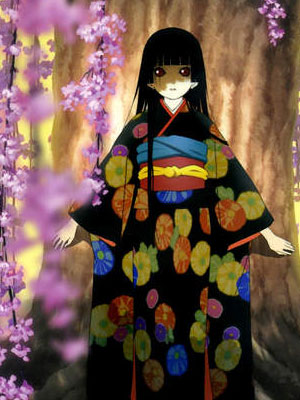
hellcorrespondence.com can only be accessed after midnight.  Type in the name of the person you wish vengeance upon and Hell Girl will appear bearing a voodoo doll.  She will explain to you the rules, your covenant, and then leave you to make up your mind.  Will you choose to send your enemy straight to hell, forsaking your own soul in the process?  Or will you find forgiveness in your heart?

Most people, they choose hell.

I had no idea what to expect from Hell Girl.  The copy on the box revealed exactly nothing about the story.  Turns out, season one is largely episodic.  Each episode is a contained story about how one person is so troubled, put upon, or otherwise desperate that their only recourse is Hell Girl.  The stories are sometimes curious, sometimes gut-wrenching, and not everyone deserves to be sent to hades.

As Hell Girl and her minions go about their vengeful business they are dogged by Hajime and his young daughter Tsugumi.  Hajime is horrified by the idea of condemning souls to hell and interferes on behalf of the antagonist, trying to convince the aggrieved not to go through with it.  Tsugumi, for her part, can't understand what the big deal is--bad people should be punished.

Hell Girl deals equally with justice and injustice.  Hell Girl herself is supposed to be neutral, simply offering a choice, but the girl is not without her own history and as the series progresses we come to know a bit more about Ai Enma.  Building slowly, introducing its audience to different flavours of vengeance--some bitter, some sweet--the show investigates the complex nature of hatred and how we are motivated by our anger, hopelessness, and desperation.

Your grievance shall be avenged.

Thursday, 7 January 2010

Black Jack: The Movie

This is what happens when you've got a hankering for anime but a) can't bear to start in on a series, and b) are too much of a lookist snob to watch anything that predates 1988. You end up cuing up a movie version of a series you've never seen. I did this once before with X and though I probably missed out on a lot of backstory, characterization, and subtext, I had no problem following along--the filmmakers knew what they were doing. So I didn't think I'd have too much trouble with Black Jack.

Black Jack is a renegade doctor. He's the best there is but he doesn't have a license and his fee is very high. The film begins in 1996, at the summer Olympics. Athletes from a number of different countries are breaking records all over the place. The close of the millennium is a very exciting time as these new "superhumans" are cropping up around the world, excelling in sports, academics, and the arts. Humanity seems poised on the brink of evolution.

Two years after operating on a young girl, Black Jack rushes to her home in an attempt to save her life. Until recently, the girl was happy and healthy, but sudden and catastrophic organ failure brought an abrupt end to her short life. The girl's parents gift to Black Jack the last picture she ever painted, but it isn't until two art collectors come calling that Black Jack realizes the girl was a superhuman artist. Black Jack's curiosity about the circumstances surrounding the girl's death deepens with this new information but he is without any clear notion of how to go about solving the mystery.

Aid comes in the form of Jo Brain who offers Black Jack a chance to join her research team. It seems that all the superhumans are dying horribly from a viral infection, and Jo needs Black Jack to help her find a cure. Black Jack refuses, but when Jo informs him that his young ward, Pinoko, is now in her custody, Black Jack has no choice but to sign on. As Black Jack gets closer to the true nature of the Moira virus, he becomes embroiled in medical establishment politics, and is unwillingly drawn into conspiracy.

Black Jack lacks that depth of story and character I was concerned I'd be missing, so I really needn't have worried. That's not to say the movie isn't interesting, but I was surprised at the amount of exposition. I did expect a certain amount of hand-holding (I can't really say why because a lot of the anime I've watched was quite well written) but Black Jack takes things to a whole new level. And it's not like the story is all that complicated.

Perhaps it's more to do with the author than the telling (if that makes any sense). Black Jack's creator, Osamu Tezuka, was a doctor, so his stories are infused with medical procedures. The movie's writer/director, Osamu Dezaki, stuck with this trend and a good deal of the exposition in the film covers the etiology of the Moira virus and other scientific matters. It's not a total waste of time, but the volume of information is a lot to take in and tends to break the flow of the story.

And the film ends with a heavy-handed environmentalist statement that comes right out of left field.

One more complaint I'll lodge is against the animation itself. The animation is actually quite good, but the characters always seem to be smiling just a little bit, which has the unfortunate effect of counteracting the seriousness of the situation. I'm not all that familiar with either Tezuka or Dezaki so it's entirely possible that's just their style--I should go back and watch Astro Boy again.

Dealing with themes of personal achievement, medical experimentation, and, oddly, environmentalism, Black Jack offers a dark look at one possible future for humanity. As our need to excel and over-achieve deepens in relation to population growth and competition, the medical establishment is well-positioned to take advantage of these desires, making us all the time better at the expense of our own lives.

I can't say I'm gonna go out of my way to take in more Black Jack; there's a collection of movies and series. But I'm glad I took a chance on this one, even if it did offer more talk than action.

Sunday, 6 December 2009

Perfect Blue

When I lived in Toronto, a friend and I would always go to this one comic book store for anime. This place had a great anime section and the guys who ran the store would shut off whatever was playing and play new stuff just for us. Through them we discovered gems like Cowboy Bebop and Utena, and it was on the strength of their recommendation that we watched Perfect Blue.

I've seen this movie a number of times and I think, on this last viewing, I might finally have it figured out.

Mima is a pop star with the trio Cham but she wants to get into acting and is being pressured by her agent to drop singing all together. When Mima gets a part on a TV crime drama, she leaves singing behind, much to her manager, Rumi's, chagrin. Slowly, Mima sheds her innocent pop star persona, and though she tries to convince herself it's necessary in order to become a real actor, in her heart she hates what she's doing. Mima's delicate psychology is further stressed when she learns about a blog called Mima's Room that details her thoughts and feelings. Soon Mima begins to confuse realities as she becomes secretly obsessed with the blog, using it to fill in the gaps in her own crumbling memories. And then the bodies start piling up and all the victims were involved with Mima's loss of innocence.

As Mima becomes evermore unhinged and unsure about the nature of reality, the film itself becomes more and more disjointed. Mimicking Mima's deteriorating sanity, the movie switches seamlessly between events in the real world, scenes from Double Bind, and Mima's imagination. And when Mima finally comes face-to-face with the truth, when she at last understands what's been happening around her, the film stubbornly clings to its fantasy--Mima is facing down a very real and deadly opponent, but everyone is still trapped halfway between reality and make-believe.

Made in 1998, the film seems a bit dated today, mostly because the Internet is still kind of new for the characters. But the movie still holds up because, I believe, a good story never goes out of style. Perfect Blue is a psychological thriller in a very literal sense. It's brutal, it's bloody, it addresses personality and psychology on a number of levels, and blurs the line between what is real and what is not.

After we watched this movie for the first time, my friend and I turned to each other, mouths agape. "Jesus," I said. "Yeah," came the reply. We were a bit confused by what we'd just seen, but also deeply unsettled because the film is, at times, hard to watch. Because it's anime, we were already one step removed from the film, and the film-within-a-film narrative further alienates the audience from some of action, but Perfect Blue features one very long rape scene and a second attempted rape, and these two moments break down any and all barriers that might separate the audience from what's happening on screen.

It's taken me multiple viewings to fully understand and appreciate everything that's going on in the film, but I don't think the movie's complexity works against it. Perfect Blue asks a lot of its audience and in return delivers a multi-layered thriller about obsession and identity.